

You are using an out of date browser. It may not display this or other websites correctly.
You should upgrade or use an alternative browser.
You should upgrade or use an alternative browser.
Film 📽️ THE CINEMA LOUNGE
- Thread starter Kane52630
- Start date
General Film

Black Narcissus
8 | 24
- Joined
- May 2, 2012
- Messages
- 35,578
- Reaction score
- 14,376
- Points
- 103
I always thought he dies at the end of the flick. But this is a pretty cool idea for a flick/books.
In 2019, Tarantino appeared on the podcast Happy Sad Confused, where he discussed Landa's fate after the events of the film. Tarantino stated that Landa is recognized as a hero in the US and history books for his involvement in ending WWII and helping kill Adolf Hitler, and that he subsequently settles on Nantucket Island, where he is roped in to solve a series of murders as an amateur master detective.
In 2019, Tarantino appeared on the podcast Happy Sad Confused, where he discussed Landa's fate after the events of the film. Tarantino stated that Landa is recognized as a hero in the US and history books for his involvement in ending WWII and helping kill Adolf Hitler, and that he subsequently settles on Nantucket Island, where he is roped in to solve a series of murders as an amateur master detective.

emielaen
Sidekick
- Joined
- Jan 2, 2020
- Messages
- 4,574
- Reaction score
- 5,659
- Points
- 103
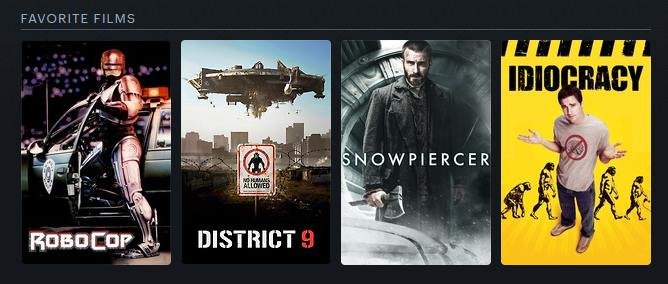
New month, new Four Favorites for my letterboxd. This theme: sci-fi classics that explain society as we know it.
View attachment 81839
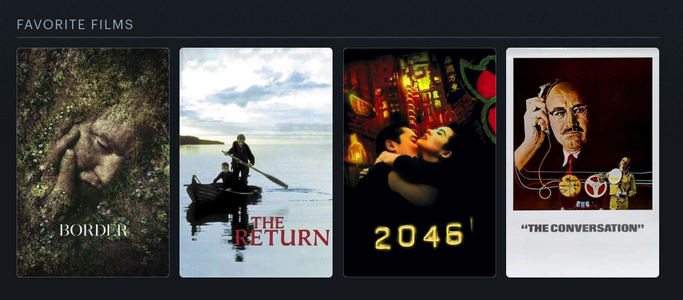
Theme: good sh**
Black Narcissus
8 | 24
- Joined
- May 2, 2012
- Messages
- 35,578
- Reaction score
- 14,376
- Points
- 103
I miss Gene Hackman.
Black Narcissus
8 | 24
- Joined
- May 2, 2012
- Messages
- 35,578
- Reaction score
- 14,376
- Points
- 103
Don’t we all.


Dr.
From parts unknown
- Joined
- Aug 19, 2010
- Messages
- 6,688
- Reaction score
- 3,687
- Points
- 103
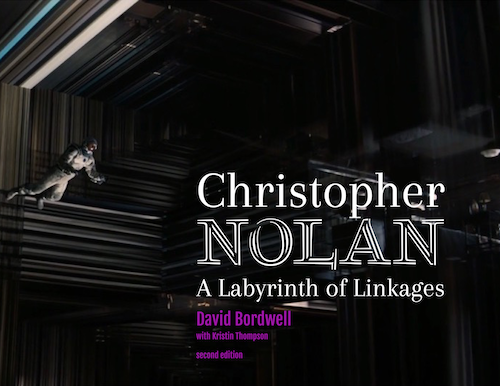
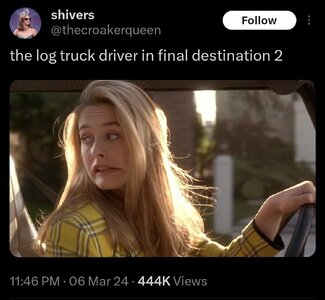
Professor and then professor emeritus of film studies at UW-Madison. This guy's books on film history and theory are required reading in many university programs. And in recent years, he seemed to be particularly interested in Christopher Nolan.

- Joined
- Aug 17, 2003
- Messages
- 72,535
- Reaction score
- 43,454
- Points
- 203
I have 4 of the 10 BP noise still to watch. I won't get to them all before the Oscar's, but I am gonna try to watch 1 or 2 more. Still haven't seen Anatomy of a Fall, Maestro, Past Lives, or The Zone of Interest. This week I watched American Fiction and just earlier I watched Poor Things. American Fiction I enjoyed. Thought it was hilarious and Jeffrey Wright was great in it. Poor Things....I can file that under I see the artistry and the performances, but the movie itself to watch.....Not my favorite experience. One of those I watched it once and likely never again type movies.
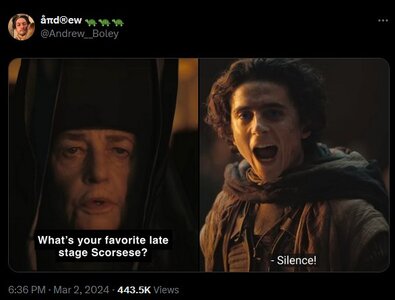
As of right now, Killers of the Flower Moon was probably my favorite of the BP noms I watched. Scorsese delivered a banger there.
As of right now, Killers of the Flower Moon was probably my favorite of the BP noms I watched. Scorsese delivered a banger there.

CaptainWagner
I'm A Worrier, It's What I Do (he/him)
- Joined
- May 29, 2014
- Messages
- 11,398
- Reaction score
- 7,395
- Points
- 103
I'm planning to watch Past Lives tonight and then I'll have checked them all off the list! Out of the 9 I've seen so far, Maestro is easily my least favorite. Oppenheimer and Killers of the Flower Moon are neck and neck for the top spot.I have 4 of the 10 BP noise still to watch. I won't get to them all before the Oscar's, but I am gonna try to watch 1 or 2 more. Still haven't seen Anatomy of a Fall, Maestro, Past Lives, or The Zone of Interest. This week I watched American Fiction and just earlier I watched Poor Things. American Fiction I enjoyed. Thought it was hilarious and Jeffrey Wright was great in it. Poor Things....I can file that under I see the artistry and the performances, but the movie itself to watch.....Not my favorite experience. One of those I watched it once and likely never again type movies.
As of right now, Killers of the Flower Moon was probably my favorite of the BP noms I watched. Scorsese delivered a banger there.
Black Narcissus
8 | 24
- Joined
- May 2, 2012
- Messages
- 35,578
- Reaction score
- 14,376
- Points
- 103
Zac Efron had an almost deadly accident. Most of the damage done to his face. Even so, with all the reconstruction work done, his face looks kinda off, no pun intended, but he is still a handsome bastah. His performance in Iron Claw any other year would've gotten him some award noms for sure. The guy who played Ric Flair is awful tho. I also keep waiting for Lily James to take none wife/gf to the lead character roles, she deserves better. Eh.
8/10
8/10
Black Narcissus
8 | 24
- Joined
- May 2, 2012
- Messages
- 35,578
- Reaction score
- 14,376
- Points
- 103
Something that kinda annoys me now. It seems like every modern flick has a token black friend side character. I'm all for more representation, but these characters really are nothing but paper thin, only there to help the lead, which are usually white and I fear mostly cast to fill a checkbox. I literally saw three modern/recent flicks back to back and was waiting for the black friend to show up like Kramer, and they did! Only really there to tell the audience, see this guy or gal isn't racist etc.
@Da-Scribe knows what I mean. Eh.
@Da-Scribe knows what I mean. Eh.


Drizzle
Here for the food
- Joined
- Apr 16, 2007
- Messages
- 39,276
- Reaction score
- 44,617
- Points
- 118
Harold is supposed to be a small child but I guess casting a manbaby is close enough. 
God, if they were going to pull something like this why couldn't they have gotten someone interesting like Nic Cage or Willem Dafoe?
God, if they were going to pull something like this why couldn't they have gotten someone interesting like Nic Cage or Willem Dafoe?

Dave McFly
YEAH!!
- Joined
- Apr 13, 2001
- Messages
- 11,842
- Reaction score
- 3,868
- Points
- 103
cause this is the 20th Anniversary of Napoleon Dynamite they are playing it on various screens and having the 2 lead actors show up after and doing meet and greet and other fun stuff and one of those showings is coming to my little city next month, I am SO looking forward to this!
sadly only Napoleon and Pedro will be there Uncle Rico was not available for my town's screening but still the 2 leads will be fun to see
sadly only Napoleon and Pedro will be there Uncle Rico was not available for my town's screening but still the 2 leads will be fun to see
Black Narcissus
8 | 24
- Joined
- May 2, 2012
- Messages
- 35,578
- Reaction score
- 14,376
- Points
- 103
Argylle
Not as bad to be honest. It was definitely too damn long tho. Bryce Dallas Howard is so thicc! Goddamn. I've always had a thing for her in them Shyamalan flicks, which was Joaquin Phoenix worst performance till date. Also, Dua Lipa is easily a WW candidate today, easy.
Eh, this was a solid 7/10.
Not as bad to be honest. It was definitely too damn long tho. Bryce Dallas Howard is so thicc! Goddamn. I've always had a thing for her in them Shyamalan flicks, which was Joaquin Phoenix worst performance till date. Also, Dua Lipa is easily a WW candidate today, easy.
Eh, this was a solid 7/10.

Kane52630
ITS TURBO TIME
- Joined
- Jan 6, 2009
- Messages
- 124,511
- Reaction score
- 64,353
- Points
- 218
A big reason why digital archives shouldn't be the only way to go for archiving.
 www.hollywoodreporter.com
“It’s a Silent Fire”: Decaying Digital Movie and TV Show Files Are a Hollywood Crisis
Industry pros sweat the possibility that many digital files will eventually become unusable — an archival tragedy reminiscent of the celluloid era.
www.hollywoodreporter.com
While David Zaslav and Bob Iger’s tax-optimization strategy of deleting films and TV shows from their streamers has triggered plenty of agita among creators, the custodians of Hollywood’s digital era have an even greater fear: wholesale decay of feature and episodic files. Behind closed doors and NDAs, the fragility of archives is a perpetual Topic A, with pros sweating the possibility that contemporary pop culture’s master files might be true goners, destined to the same fate as so many vanished silent movies, among them Alfred Hitchcock’s second feature, The Mountain Eagle, and Ernst Lubitsch’s Oscar-winning The Patriot.
It’s underscored by initiatives such as Martin Scorsese’s Film Foundation. “The preservation of every art form is fundamental,” the industry icon says on a video on the organization’s web site. For the business, these are valuable studio assets — to use one example, the MGM Library (roughly 4,000 film titles including the James Bond franchise and 17,000 series episodes) is worth an estimated $3.4 billion to Amazon — but there’s a misconception that digital files are safe forever. In fact, files end up corrupted, data is improperly transferred, hard drives fail, formats change, work simply vanishes. “It’s a silent fire,” says Linda Tadic, CEO of Digital Bedrock, an archiving servicer that works with studios and indie producers. “We find issues with every single show or film that we try to preserve.” So, what exactly has gone missing? “I could tell you stories — but I can’t, because of confidentiality.”
Specialists across the space don’t publicly speak about specific lost works, citing confidentiality issues. So, only disquieting rumors circulate — along with rare, heart-stopping lore that breaches public consciousness. One infamous example: In 1998, a Pixar employee accidentally typed a fatal command function, instructing the computer system to delete Toy Story 2, which was then almost complete. Luckily, a supervising technical director who’d been working from home (she’d just had a baby) had a 2-week-old backup file.
Experts note that indie filmmakers, operating under constrained financial circumstances, are most at risk of seeing their art disappear. “You have an entire era of cinema that’s in severe danger of being lost,” contends screenwriter Larry Karaszewski, a board member of the National Film Preservation Foundation. His cohort on the board, historian Leonard Maltin, notes that this era could suffer the same fate as has befallen so many silent pictures and midcentury B movies. “Those films were not attended to at the time — not archived properly because they weren’t the products of major studios,” he says.
In part, the indie filmmakers’ digital crisis can be traced to inadequate storage safeguards. (Innumerable thumb drives and hard drives are half-forgotten, only to age and corrupt, in closets, under beds and on garage shelves.) But also, it speaks to the fragile ecosystem that ostensibly supports filmmakers, from overextended financiers to ephemeral distributors. “They’re worried about getting the project picked up and getting it out there; proper preservation isn’t thought about so much,” observes Gregory Lukow, chief of the Library of Congress’ National Audio-Visual Conservation Center, which now digitizes physical media.
The sheer volume of now-available digital material can be overwhelming, both as a practical matter (storage costs accrue) and a curatorial one. But it’s also been a boon. In the realm of nonfiction unscripted materials, there’s often a new wealth of outtakes and preinterviews, and with scripted features and episodics, scenes that didn’t make the theatrical cut or debut on TV but provide an invaluable understanding of the work’s development. “When all we focus on is the final product, we’re missing the creative process,” explains May Hong HaDuong, director of the UCLA Film & Television Archive.
Those in the preservation community say it’s best in terms of time and expense when proper protocols are put in place up front. (Too often, it doesn’t happen.) “It’s a different budget and a different model when it’s done later on,” says Lance Podell, senior vp at Iron Mountain Entertainment Services, a data storage and restoration firm. “To go back and make something searchable, retrievable, locatable is a more expensive and time-consuming process than if you’d done it out of the gate. And there’s the loss of institutional memory because the people involved in making the work are often no longer around.”
The Academy of Motion Pictures Arts and Sciences’ SciTech Council has spent years fretting about the issue. Yet Andy Maltz, who co-authored the council’s reports on the topic and is now principal at the consultancy General Intelligence, notes that the situation is “not dire like it was, the industry really stepped up.” This includes the development and growing use of the Academy Color Encoding System, employed to communicate color and other information.
Paramount senior vp asset management Andrea Kalas, who leads the SciTech Council’s preservation initiatives, emphasizes that the best practice for preserving a film that was shot digitally is to “have a copy of that final film in the best possible resolution, in the widest color gamut, so you have the most original materials associated with that film.” She adds, “If you are moving your files to an infrastructure of some sort, whether that’s a data center or a set of clouds, people are thinking about storage policies like keeping multiple copies. There are also people that choose to store things offline like on LTOs,” referring to a tape-based format that’s been utilized for decades. Good old-fashioned — and time tested — film also remains in use.
Maltz warns that with the nature of digital, preservation efforts can’t stop. “The data that you are protecting needs consistent migration. You really can never take your eye off the digital ball. That why you have backups, it can happen at any time. The odds are pretty low [of losing a film] — but there are still odds.”
Migration is also necessary as file formats evolve. “If you have a Zip drive with TARGA files on it, do you know how to open those today?” asks Alex Forsythe, director of imaging technology at AMPAS, referring to a 1980s-era file typology that has since been eclipsed by newer, more efficient methodologies. “I don’t think anyone expects these file formats to last a dozen years, let alone 50.”
Some preservationists are more sanguine. Larry Blake, a longtime sound supervisor and postproduction adviser for Steven Soderbergh who’s writing a book on digital preservation issues, believes that concerns over evolving formats are overstated. “I’m not worried that the Library of Congress won’t have the smarts to decrypt in a century,” he says. “Whatever standards change, the DCP [a standardized file package format] isn’t going away,” adding: “Also, there are other ways to outlive the cockroaches, like maintaining an image sequence of 150,000 TIFF files, numbered in sequence, for picture, and then a matching stretch of broadcast-wave sounds for audio. You give any archive that and it’s game, set, match.”
Experts hope that evolving tech will help more than hinder, often pointing to the notion that artificial intelligence may soon aid in rediscovery. “That would be a game-changer,” says Arthur Forney, head of postproduction for Wolf Entertainment. His colleague Mark Dragin, a supervising producer for three of the company’s Law & Order series, notes that Special Victims Unit began in 1999, and was shot on film, so pulling a flashback — for instance, of star Mariska Hargitay pursuing an old case — can be laborious, especially if it’s from an outtake. He says, “This might make it quicker to find that needle in a haystack.”
Drizzle
Here for the food
- Joined
- Apr 16, 2007
- Messages
- 39,276
- Reaction score
- 44,617
- Points
- 118
Sure, we get crap like that but we'll probably never get a movie where Freddy, Jason, Michael Myers, Leatherface, Chucky, Leprechaun, Ghostface, Pinhead and Candyman all team up to kill a bunch of teenagers and then fight each other.
Similar threads


- Replies
- 1K
- Views
- 48K


Users who are viewing this thread
Total: 4 (members: 0, guests: 4)


