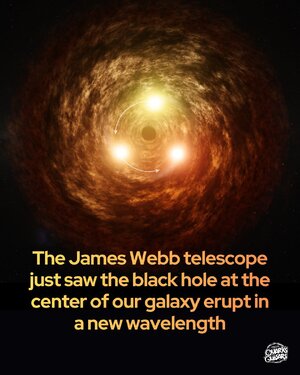
After 20 years of trying, astronomers finally saw this flare.
For the first time, scientists have detected a mid-infrared flare from Sagittarius in A* – the supermassive black hole at the center of the Milky Way. It lasted just 40 minutes, but what it revealed could reshape our understanding of black holes and the magnetic chaos around them.
The flare was caught by the James Webb Space Telescope, using its ultra-sensitive mid-infrared instruments. Until now, astronomers had seen flares from this black hole in radio, near-infrared, and X-ray – but the middle of the infrared spectrum was missing. This detection fills a long-standing observational gap.
So what caused the flare?
Models suggest it was triggered by magnetic reconnection – when two twisted magnetic field lines around the black hole snapped together and released a burst of energy. That energy launched relativistic electrons (nearly at the speed of light), which spiraled through magnetic fields and emitted synchrotron radiation – the light JWST captured.
Even more exciting, scientists saw how the flare’s spectral index changed over time – direct evidence of synchrotron cooling, where high-speed particles lose energy as they emit light. That let them measure the strength of magnetic fields near the event horizon with unprecedented clarity.
These observations, backed by simulations run on Canadian supercomputers, help unlock how black holes feed, flare, and shape the galaxies around them.
We determine the mid-infrared (MIR, $\sim$5~μm--22~μm) extinction towards the Galactic center using MIRI/MRS integral field unit (IFU) observations of the central $3''\times3''$ region (near 5~μm) to $7''\times7''$ region (near 22~μm). To measure the MIR extinction, we employ two approaches...

arxiv.org










 Lily Adler🎄 Peppermint Mocha 🍫
 squeeknessI'm a poor lost puppy
 SwordOfMorningSuper Moderator

 In the Kitchen with DKDetective and InCali: All Things Food, Wine, and Spirits, Etc. (6 Viewers)